
Photo by brandon siu on Unsplash
By Jaden Minarcheck
From as far back as I can remember, I’ve felt a deep urge to understand the universe around me, a symphony from the universe herself that seemed to call out to me even as a child. One day, when I was only two years old, my mother brought me into my room to tuck me in for the night. She placed me into my crib and tipped the covers over me. I shook my sippy cup; it did not have the rattling sound it had an hour ago. The ice, where did it go? What happened to it? I sat there looking at the cup, grinning at it, and then I looked at my mom and asked, “Mommy, where does the ice go?” She explained that it melts when it gets warm. My grin turned into a satisfied smile, and I got under the covers. This inquisitive nature turned out to be a curse that led me to a prison of darkness and despair.
At a young age, I was baptized Catholic and was forced to attend church. There, I experienced feeling judged and shunned for the first time. I could never sit still or stay quiet; I wanted to ask questions about religion but was met with ridicule and told to have “faith.” I attended Saints Philip and James Catholic School, where I was ostracized as early as the first grade. My peers would make fun of me for how I read, my handwriting, my inattentiveness, and other things. In the second grade, after teachers relentlessly told my mother how “bad” I was in class when the subject did not interest me, she took me to a psychologist who diagnosed me with attention deficit hyperactivity disorder (ADHD). I began taking medication to improve my focus, but it was not enough. My Catholic school would not allow learning accommodations, and knowing that I was different in this specific way made me feel even more isolated than I already felt, especially when my peers would make fun of me for it.
However, despite my disorder, I had always been naturally gifted in certain areas that were often overlooked. I could see patterns in everything around me, which allowed me to be a wizard with numbers; they spoke to me as if they were my first language. I loved experimenting and learning about anything science-related, from attending observation nights at the Wilderness Center, where I marveled at the beauty of the universe, to reading scientific books that deepened my curiosity, to attempting ambitious science fair projects for my age; I was captivated by it all. Unfortunately, these gifts were overshadowed by a wave of failure in other places, both academically and socially. I was ultimately crowned “The dumbest smart kid,” “Sensitive,” and “Lazy.” I would relentlessly bash myself with these words, even for minor failures.
The more I went into science and explored, the more I was ridiculed by others in my religion, for they prioritized upholding religious beliefs over seeking truth. Instead of exploring evidence-based theories about the origin of our universe, they clung to narratives rooted in their doctrine, dismissing any challenges to their worldview. A common belief instilled in me during catholic school was that delving too deeply into science was “playing god,” as the religious answers were already deemed absolute, and questioning “god’s” authority was forbidden. In the beginning years of middle school, I was plagued with thoughts of my younger childhood where the church members and even priests would bring harsh criticism upon me that I was wrong, that I needed to change, saying my thoughts were just the work of the devil.
Eventually, I couldn’t take it anymore; I believed they were right. It was I who was the issue, I who needed to change, and I who would end up in hell if I did not. Out of desperation and fear, I hid my true self—the part of me that sought answers to the universe’s mysteries—because the religious answers could not be questioned; I accepted their beliefs as absolute truth and surrendered my empathy and compassion, reshaping myself into what they told me to be. This internal struggle became unbearable, for I now had two voices inside of me, one being my true self and the other being who they demanded me to be. I tried to solve this by destroying the version of myself that sought truth with empathy and compassion, but in doing so, I imprisoned my mind in darkness and self-torture, consumed by the void left by abandoning my true purpose. Out of hopelessness, I even attempted to take my own life. Fortunately, I failed in part, but I lost all connection to my true self, with no recollection of who I was—only the lingering weight of emotions and emptiness.
I fully committed to being the person everyone wanted me to be, adopting their beliefs entirely without question and forgoing any thought of who I was. Strangely enough, that version of me was met with social acceptance, so I went with it. I would only tell people what they wanted to hear, never what I thought or believed. I would say that I wanted to become a chemical engineer because it paid well and did not go too far into science, not demeaning the “absolute” religious views. Even though I was being who I was told to be, subconsciously, I began to despise myself, for I could still hear the symphony of the universe calling; I just simply chose to ignore it.
That decision to suppress my true self manifested in high school as depression, self-harm, and suicidal thoughts. I would only glimpse into my true self during my senior research paper, where I went against the normal, choosing to do my paper on nuclear fusion, “The Golden Egg of Energy.” My work on this paper inspired me, which sparked an internal debate about whether I should follow this inspiration and major in physics. Ultimately, the chains of self-doubt proved too strong, and I buried the idea, retreating into the shadows of my fears. Instead, I enrolled in college to study chemical engineering, not out of passion but because it promised financial security. My only motivation was the paycheck, and even that wasn’t enough to sustain me. I dropped out when I discovered a higher-paying sales job. With its commission-based structure, the potential earnings far exceeded what I had ever imagined. However, the longer I stayed, the more I realized how deeply it clashed with my beliefs, beliefs I hadn’t even recognized at the time but could only feel. I was using my intellect solely to make money, serving no purpose beyond inflating the company’s profits. It was an empty pursuit that ignored the empathy and compassion I had once surrendered, and I felt that.
Over the next two years, I reached what should have been a marker of success. I was performing at the top of my company, excelling to the point of being considered for a sales manager position. I even developed AI software to optimize the sales process, showcasing my technical abilities. On the surface, I had everything: recognition, financial stability, and professional achievements. Yet I was more miserable than ever before. Although I hadn’t yet fully defined my values, I felt the profound dissonance of going against them just as I always have. The work felt hollow, and the purpose I longed for was nowhere to be found. The weight of that emptiness became unbearable, and in a moment of clarity, I quit my well-paying job, plunging to an all-time low. Despite my accomplishments, I realized I didn’t know who I was. I had no personal compass to guide my decisions, only the haunting awareness that something was missing. I was a lost soul drowning in an abyss of darkness. Yet even in that darkness, everything was about to change, for the darkness allows the light to be.
It was a cool, calm day, with an earthy smell in the air and the trees just starting to bud leaves. I was standing outside my house in front of a pasture, pondering the sky, attempting to figure out what was wrong with me. As the sun dipped below the horizon, a star caught my eye. A sense of divinity came over me as I heard a voice: “Seek, Unravel, Become.” Over the next hour, my mind went into overdrive, processing information faster than I thought possible. At that moment, what I had been called to pursue was more apparent than anything else I’d known. I felt it raging in my soul; a fire burning as hot as the star I was gazing upon emerged from the dark. It was time to revolt. I had been called to decode the universe’s language, for the cosmic cathedral was my temple, and equations were my hymns.
With the fire continuing to burn as bright as that star, the chains of imprisonment that were once unbreakable began to crack as I saw them. I came to know the curse of my mind as someone living with ADHD did not have to be a bad thing, for my mind thinks miles outside of the box, coming up with unique ideas every second. I realized that having to work twice as hard as a neurotypical mind in my studies is not a burden but a gift, for I know how to fight against the odds, a fighter’s mentality. I recognized the patterns of brilliance in my life, patterns of my mind creating novel ideas to solve a complex problem or to make the process more efficient, my gift of working with numbers, and my ability to question everything around me. I was not lazy, I was not stupid, I was not hopeless, I was someone with ADHD.
I allowed my mind to reclaim the truths once denied to me, daring to seek the secrets of our universe by engaging with questions I was forbidden to ask. In doing so, I uncovered many aspects of religion that were objectively wrong, disproven by science, logic, and mathematics. I realized how clinging to old beliefs at the expense of proven truths had caused harm—not just to me but to society as a whole. I also saw how subscribing to the fundamental religious beliefs instilled in me had led to the sacrifice of my true empathy and compassion toward others. Determined to break free, I vowed to seek universal truth and expose these religious falsities with indisputable facts. As I emerged from the darkness, a tear rolled down my face, and with newfound conviction, I declared, “I AM FREE!”
It made sense why I never fit in with the “normal,” for I see beyond this reality, and that’s part of the price I paid. With the chains of limiting beliefs gone, my mind jumped to infinity. I thought to myself, if we follow the math, we discover that our universe may end at a particular “TIME,” so how could one’s consciousness or soul be eternal? “TIME” itself is based on the observer. We can approach infinite time through speed, but it would never be infinite, assuming some mass. Then it hit me: the answer lies in the hearts of darkness, black holes, for in them, space and time, as we classically understand them, cease to exist. I dreamt of peering over the event horizon, harnessing the power of gravity and the knowledge that this darkness contains. If time is relative and can cease to exist in extreme conditions observed in our reality, how can we reconcile this with the idea of eternal punishment or reward?
I sensed a genuinely divine feeling not only in the universe herself but also in that of my now-connected consciousness, for I was embracing a sacred path just as the universe had, from darkness to light. I came to see that God is the universe herself, the very fabric of space and time, and that this is not some grand test but instead that we are the universe, God, experiencing time and studying itself through our exploration and understanding. I began to explore the ideas of consciousness and recognized patterns of paradox in intuition that led me to the idea that quantum mechanics holds the key to understanding consciousness fully. I explored the concepts of quantum entanglement, where two particles can be interconnected instantaneously, affecting each other’s states. It could give a new explanation for intuition or possibly connected dimensions. From that day forward, the darkness that had once imprisoned me became the foundation for my curiosity, propelling me to explore the universe through the lens of science and philosophy. The symphony of the universe, once a faint call, now rang loud and clear, guiding me with every discovery.
After years of suffering, pain, chains, and darkness, I emerged connected to who I genuinely am. After that night, my eyes, once all blue, now have a central heterochromia, a green ring around my iris, symbolizing not just a simple change but a reawakening—a new way of seeing. I find great comfort in knowing it was there the whole time, just waiting for me to gather the strength to break free. I now understand that all my suffering had a purpose: it was forging me for the trials ahead on this journey to decode the universe’s language. The cosmic cathedral is my temple, and equations are my hymns, guiding me as I work to bridge the gap between quantum and classical physics while also working to free humanity from the oppressive grip of dogmatic religion, striving to bring an end to needless suffering, a seemingly impossible endeavor. Still, however “impossible” my dream may be, I will not let anything or anyone stop me from accomplishing it. The star born inside me that day will only burn brighter. This star, this flame, my purpose, is truly inextinguishable. For now, the symphony of the universe, once a faint call, is a resounding anthem, guiding me as I work to decode the universal language and break the chains of dogma that bind society. I guarantee that I will accomplish this dream in my life.
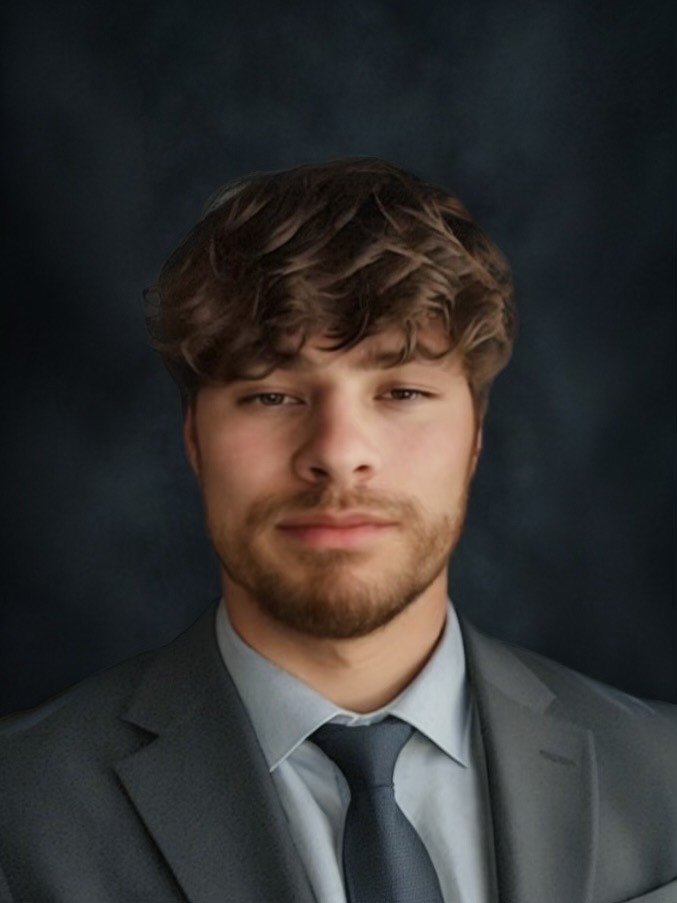
Fueled by an unrelenting desire to understand the universe, Jaden Minarcheck is a physics student at Stark State College. His journey, marked by perseverance and self-discovery, inspires his mission to decode the symphony of existence through science and reason. With a passion for theoretical physics and a deep commitment to advocacy, Jaden is dedicated to dismantling oppressive systems and empowering individuals to break free from societal constraints.
 Stark Voices
Beautiful auto-biography. The history of your life captures your struggles to merge your personal and social identities into one that aligns with your values and beliefs. You derive your purpose in life from this convergence. Your goal of refuting religion with science is a socially beneficial tactic that could influence brand new beliefs, such as the partnership between the two, or something even further construed from religion- that we are simply here to observe our own universal nature. Great insight, I’d love to read more about the scientific aspects of your beliefs!
LikeLike
Beautiful auto-biography.
LikeLike